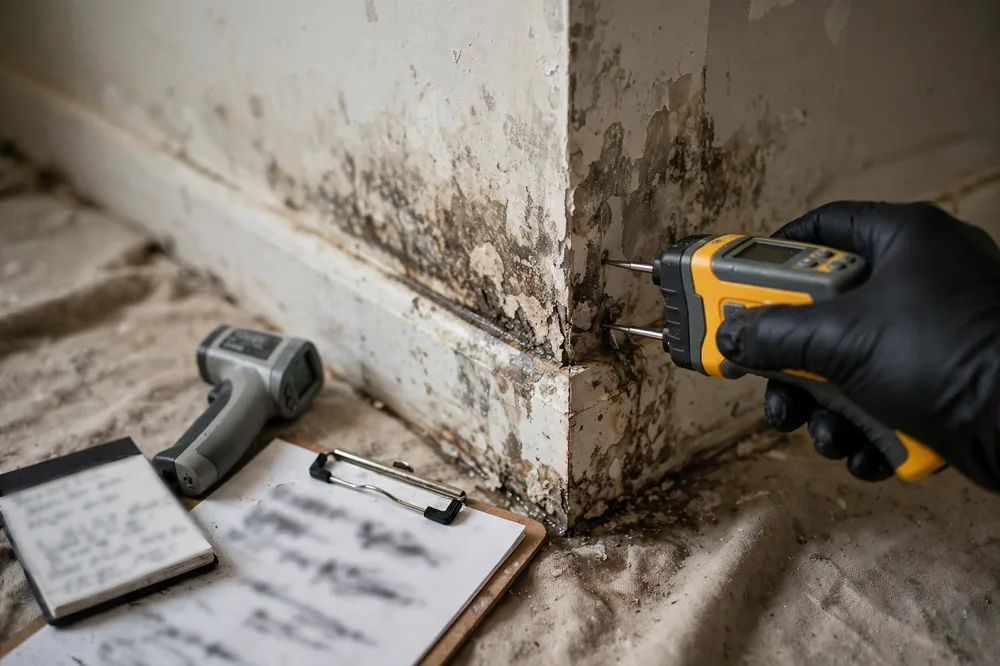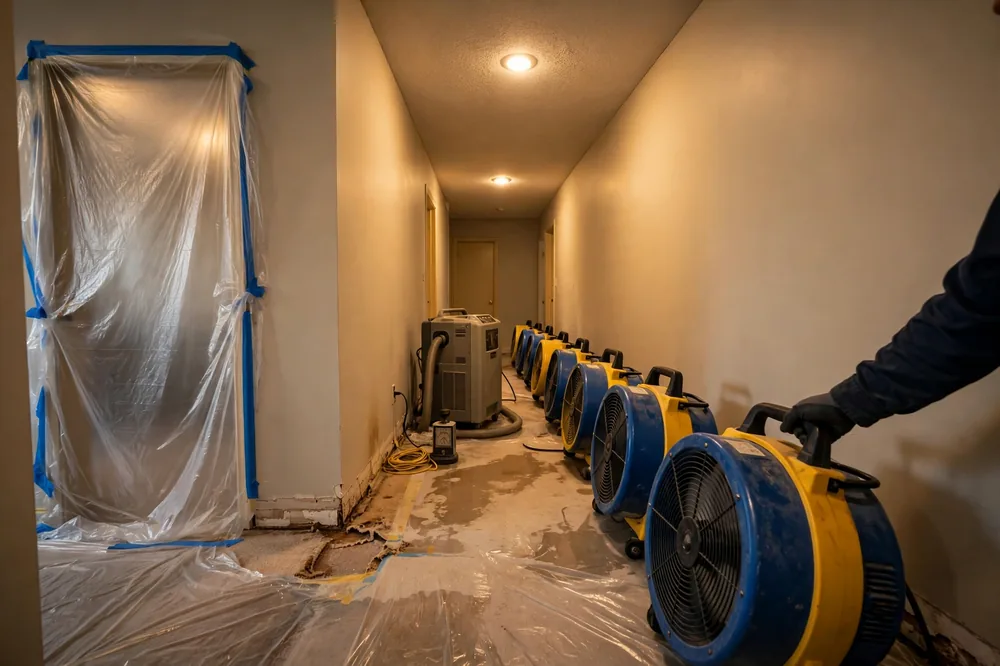
Drying is the phase that decides what survives. Air movers, dehumidifiers and a moisture log β placed from readings, adjusted on return visits, and stopped by measurements rather than by the calendar.
Tell us what got wet, when, and what drying has happened so far. We match the job with an independent local pro, and the pro confirms the scope of the work with you before any work begins.
π Call Now Prefer email? Write to us βNo forms, no obligation. A referral service β not a direct service company.

Structural drying is applied physics with a clipboard. Evaporation moves moisture from wet material into the air; dehumidification removes it from the air before it can settle somewhere worse; air movement keeps the exchange going at the surface. The balance among the three β sized to the room's materials and moisture load β is the craft, and the moisture log is its proof: readings at the same points, day after day, falling toward the dry standard of unaffected material.
California argues with drying in two directions. Inland valleys in summer hand you hot, dry air that tempts everyone to open windows and call it drying β while cavities and floor systems stay wet untouched. The coast hands you marine-layer humidity that stalls evaporation and demands dehumidification capacity sized generously. Winter storms wet homes in the season when ambient air helps least. The equipment plan has to answer the local air, not the brochure.
Drying is also where assemblies are won or lost. Water inside a wall cavity, under a hardwood floor or inside a slab-adjacent floor system does not leave because the room feels dry. Directed air β into cavities through small ports, under flooring with mats β and probe readings at depth are what separate a verified-dry structure from a surface-dry story.
The full drying discipline, from first map to final verification.
The wet footprint is mapped in materials and at depth, and the equipment plan β placement, capacity, targets β is built from that map.
Air movers are aimed across wet surfaces at the angles and spacing that drive evaporation, adjusted as readings move.
Refrigerant or desiccant dehumidifiers pull the evaporated moisture out of the air, sized to the room volume and the material load, with drainage managed for continuous running.
Directed air systems dry inside wall cavities and beneath flooring through small access points, where readings show water the room air cannot reach.
Return visits read the fixed points, reposition equipment toward the slow spots, and record progress β the log your claim file will ask for.
Drying ends on a verification reading: wet points at the dry standard of comparable unaffected material, stable on a final check.
Five steps that turn wet structure into verified dry structure.
Drying runs on three mechanisms and one habit of measurement.
Low-profile fans that push a sheet of air across wet surfaces β the evaporation engine, placed by angle and spacing rather than scattered.
Refrigerant units handle warm, wet rooms efficiently; desiccant units pull moisture in cool or stubborn conditions. The load and the weather choose between them.
Hoses and mats that deliver air into wall cavities and across subfloors beneath finished flooring β drying the assemblies that room equipment cannot reach.
Pin, pinless and probe meters read surfaces and depths at fixed points. The log is the method: without it, drying is weather; with it, drying is engineering.

How common California drying scenes look at setup, and at verified completion.
Surface boards drying while the subfloor beneath holds the real moisture load.
Floor mats drawing moisture from the system, probe readings at target, finish saved where the numbers allowed.
Drywall face dry to the touch, insulation and studs wet inside the wall.
Directed air run into the cavity, probe readings falling daily, no demolition beyond the access points.
Marine humidity stalling evaporation, surfaces cool and damp for days.
Desiccant capacity sized up, zone sealed from outside air, readings reaching target on schedule.
Proper drying exists to prevent the failures that surface drying invites.
The most expensive illusion in water work. Depth readings and directed air dry the whole assembly or expose honestly what must open.
Assemblies that stay wet past the second day are where growth starts. A drying plan measured daily is what keeps the second week from becoming a remediation.
Without a log, the repair phase starts on somebody's opinion. The verification reading turns that gate into a fact both you and your insurer can read.
The first map weighs these factors before equipment is placed.
Tile on concrete dries in the open; insulated cavities and layered floors dry on equipment and time. The assembly list is the scope.
How much water the structure holds and how far it traveled set capacity β the number and size of units, and the days on the log.
Coastal humidity, inland heat, winter storms β the local air decides how much dehumidification the balance needs.
Drying around a household that stays in place, versus an empty home, changes containment, noise planning and equipment layout.
Timelines, equipment noise and what verified dry actually means.
Nine other ways the network helps California homes after water gets in.
Tell us what got wet and when. We will match your job with an independent local water damage professional who serves your city.
π Call NowCalls are the fastest route β water does not wait for inboxes. Email works too if the situation is stable and you are planning ahead.
One call is the whole intake: where the water is, what caused it, when it started. We match the job locally from there.
π Call NowStable situation, planning ahead? Send photos and a short description and we will line up the right local pro.
rankandrent2+water-damage-california@gmail.comMonβFri 7 AMβ10 PM Β· Sat 8 AMβ10 PM Β· Sun 7 AMβ9 PM (Pacific Time). Water does not keep office hours, and neither does the damage it causes β call as soon as you find it inside those hours and we will get the match moving.
See service areas βTell us what happened once. An independent local water damage professional confirms the scope of the work with you before any work begins β no obligation, no pressure.